 713-722-7800
Top 5 Questions Business Owners Ask About Ultrasonic Testing
Top 5 Questions Business Owners Ask About Fire Sprinkler Ultrasonic Testing
In modern commercial buildings, the fire sprinkler system is the single most critical asset for protecting people, property, and business continuity. To prevent system failure, routine maintenance involves internal pipe assessments that check for corrosion and thinning. Traditionally, this process was invasive and disruptive.
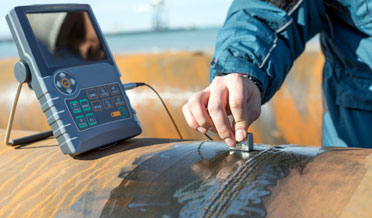
Ultrasonic Testing (UT) is a non-destructive, non-invasive method for accurately evaluating internal pipe integrity. Business owners moving to this innovative technology naturally have crucial questions about its process, cost, and reliability compared to traditional inspections.
Here are the top five questions business owners ask about fire sprinkler ultrasonic testing.
- Will Ultrasonic Testing Require Me to Shut Down My Business Operations or My Fire Protection System?
This is arguably the most critical concern for any business owner: preventing downtime.
The definitive answer is no.
Ultrasonic testing’s key feature is the non-invasive and non-destructive process. Traditional assessments require the system to be turned off, draining the system, and removing sections of pipe to visually inspect the sample. The fire sprinkler system cannot be reengaged until the removed section is repaired. Ultrasonic testing can be performed if the fire sprinkler system is pressurized and fully functional.
By not shutting the system down, your business can be fully operational. Your business, customers, tenants, and company assets are fully protected while the testing is carried out.
- How Does the Cost and Time Compare to Cutting Out Pipe Samples?
When evaluating any maintenance investment, cost-effectiveness and efficiency are paramount. Ultrasonic testing provides clear financial and logistical advantages over invasive methods:
- Significant Cost Savings: Since ultrasonic testing does not shut down the sprinkler system and allows business as usual, it is a more cost-effective option to traditional pipe inspection. It eliminates the labor, materials, and specialized welding required to cut out samples, replace pipe sections, and then refill the system.
- Time Efficiency: The entire UT process is fast. While traditional assessments can take days or weeks due to system draining and pipe repair, UT is completed in a matter of hours.
- Water Conservation: Because the system is not drained and refilled, UT conserves thousands of gallons of water, making it an environmentally friendly choice.
By reducing labor, eliminating materials, and preventing operational downtime, UT offers a superior cost-effective solution for maintaining the required inspection schedules.
- What Internal Problems Can Ultrasonic Testing Actually Detect?
Business owners want assurance that a non-invasive test is still a comprehensive one. Ultrasonic testing provides a valuable assessment of the internal stability of your system’s pipes and detects issues that are not visible from the outside.
- Pitting and Corrosion: Pitting and corrosion are the biggest threats to sprinkler systems. Corrosion and pitting can lead to leaks and the ultimate failure of the system’s piping. Ultrasonic testing precisely measures pipe wall thickness to identify any issues with pipe integrity.
- Hard Water Build-up: Hard water can produce scaling, reducing the system’s water flow.
- Air Pockets: Ultrasonic testing will identify any air bubbles within the system’s pipes. Trapped air can accelerate corrosion in wet sprinkler systems.
By providing quantitative data on the extent of deterioration, UT allows for proactive maintenance rather than reacting to a failure or leak.
- How Does This Method Improve System Reliability and Future Planning?
The data generated by ultrasonic testing is not just a snapshot in time; it’s a vital tool for long-term facility management and budgeting.
- Quantitative Data: Ultrasonic testing provides precise wall thickness in multiple sections of pipe in the system.
- Life Span Prediction: By using the data gathered, compromised sections of pipe can be identified and allows forecasting of other pipe sections as they near end-of-life.
- Replacement Budgeting: Using the quantitative data gathered during testing, facility managers can be proactive instead of reactive to emergency repairs. Replacement plans can be created to replace near failing piping to avoid catastrophic failure and allow for better budgeting.
Taking a proactive approach to system testing will improve safety, enhance sprinkler system reliability, and reduce system failure risks.
- Is Ultrasonic Testing Compliant with Code Requirements for Inspection?
Compliance with industry standards and local fire codes is non-negotiable for business owners.
While UT is an advanced and highly accurate method for measuring pipe wall integrity, business owners should understand how it integrates with required fire standards, such as NFPA 25 (Standard for the Inspection, Testing, and Maintenance of Water-Based Fire Protection Systems).
Ultrasonic testing is recognized as a vital tool for performing internal pipe assessments. When used by a professional fire protection company, UT serves as the foundation for a thorough and defensible inspection report. For comprehensive compliance, experts can use UT to pinpoint the worst areas, confirming wall thickness, and then follow up with any required minor physical inspections to visually confirm the absence of foreign material, ensuring all code requirements are fully met without excessive system disruption.
By choosing ultrasonic testing, you are investing in a modern, data-driven strategy that ensures your fire sprinkler system meets all safety and compliance mandates while protecting your operational bottom line.
Contact Fire Safe Protection Services today at 713-722-7800 or visit our online form, and we will be in contact as soon as possible about your commercial fire sprinkler system ultrasonic testing questions.