
 713-722-7800
Industrial Fire Alarm Systems
Industrial Fire Alarm Systems Best Practices
During the early days of the Industrial Revolution, manufacturing facilities increased in area and complexity exponentially, and office/business spaces grew wider and taller. Early designs and construction focused on function and had little consideration for safety or emergency planning. Emergencies did happen and often the results were the disastrous loss of life and property.
In 1867, shortly after the Civil War, Massachusetts took note of the loss of life in industrial accidents and began safety inspects for factories. Various state and federal agencies were formed to investigate workplace accidents, require safety improvements, and enforce safety features in workplace environments. While accidents still occur, safety design and planning dramatically reduce workplace loss.1
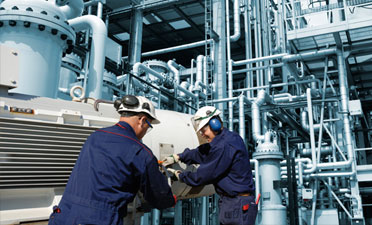
A good example of the safety features designed into industrial complexes is industrial fire alarm systems. Industrial technology often brings people into close proximity to high voltage electricity, heat, flame, and hazardous—sometimes flammable—chemicals. Industrial complexes must test and maintain elaborate smoke and fire alarm systems, usually with voice notification systems. Recent advances in communication technology allow an expansion of the fire alarm system for increased flexibility and effectiveness.
Networked Industrial Fire Alarm Systems
Large industrial complexes cannot rely upon a single alarm center but require multiple systems that are networked together. An alarm panel in several locations monitors the whole facility and sends constant messages to a central monitoring station. However, each individual panel can operate separately, ensuring the integrity of the entire system should one panel be lost in a fire incident. The everyday function of this type of system reduces the cost of monitoring multiple alarm systems and provides vital log information for inspections and reports. During a fire event, the integrated systems send out mass notifications throughout the facility.
Improved Communications in Mass Notification
Large alarm systems can be greatly improved with mass notification systems (MNS). The alarm system will always include a voice direction, such as “There is a fire, evacuate immediately.” MNS systems can also push text and email messages throughout the facility, even sending messages to employees who are not on site. In addition, the MNS can:
- Be modified to include notification of a tornado, a chemical spill, a gas leak, or an active shooter.
- Be modified with specific instructions concerning evacuation routes or a shelter-in-place message.
- Enable real-time updates, instructions, and assistance.
The goal of pairing the fire alarm system with an improved mass communication system is effective, streamlined communication to employees during a confusing, chaotic event. The result will be a quicker emergency response and saving the lives of employees.
Have questions about Industrial Fire Alarm Systems?
Call Fire Safe Protection Services today at 713-722-7800 or visit our online form and we will be in contact as soon as possible about Industrial Fire Alarm Systems.
1 https://www.pearsonhighered.com/assets/samplechapter/0/1/3/4/0134678710.pdf