 713-722-7800
Commercial Fire Suppression System
In the last article, we introduced Fire Sprinkler systems, with a promise to share more about Commercial Fire Suppression System. To recap,
Commercial fire safety is a service industry, involved in many commercial, industrial, and manufacturing sectors. As you might imagine, our industry has developed its own jargon. If your involvement in this industry is limited, titles and acronyms might have little meaning. As a service, Fire Safe will define several major services in enough detail to appreciate them.
Fire Sprinklers
Fire sprinklers use water to extinguish fires; by comparison, fire suppression systems use foam, dry chemicals, or gas to suppress fires. The purpose of both is to extinguish a fire as quickly as possible, saving both lives and property.
Commercial Fire Suppression System
The purpose of both systems is to extinguish a fire and to save lives and property. However, not every fire can be or should be extinguished with water. Often, the potential damage from extinguishing a fire with water is an unacceptable risk.
- Water will spread a kitchen grease fire long before it extinguishes the fire
- A room full of computer servers and advanced computer equipment would be irreparably damaged by water
- An archive, containing irreplaceable documents is highly susceptible to fire damage, but water damage would do as much damage
- Water used to extinguish a fire in a storage facility for paints, lubricants, or other hazardous materials might contaminate local groundwater
A waterless suppression system minimizes damage to equipment and assets with little or no mess. A suppression system will extinguish a fire by separating one or more of the three necessary parts of a flame: ignition/heat, oxygen, and fuel. It is designed to extinguish a fire that water cannot extinguish.
Types of Commercial Fire Suppression System
Each industry sector negotiates unique fire risks, so there are no “cookie-cutter” suppression systems. The following list is just a sample of available chemical fire suppression options:
- Wet Chemical Suppression Systems. This application is a localized fire suppression system. A restaurant facility might utilize a water sprinkler system throughout the facility, but use a Wet Chemical Suppression system over fryers and grills. The system will use an agent such as potassium carbonate solution, sprinkled as fine droplets above the ignition source.
- Potassium carbonate is a soap-like liquid that covers the fuel of a grease fire, separating it from the fire. It also prevents the hot oil from splattering and spreading.
- This product also undergoes a process called vaporization which removes the heat from the ignition, quickly cooling the flame.
- Potassium carbonate is safe to use around people. It will require some cleanup.
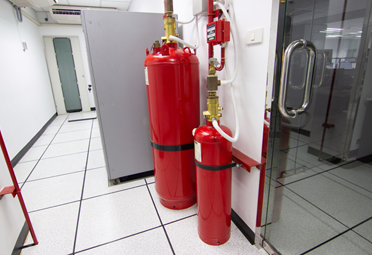
- FM 200 Suppression Systems. This application is also a localized fire suppression system. A technology center might utilize a water sprinkler system throughout the facility but use an FM 200 Suppression system for a server room.
- FM 200 is a colorless, compressed liquefied gas that is deployed very quickly—within 10 seconds of sensing an ignition.
- The chemical inhibits the chemical reaction between the fuel and oxygen, extinguishing the fire. It also absorbs the heat of the fire from the surface of the burning material, lowering the temperature below the ignition point.
- The gas dissipates quickly and no cleanup is required.
- FM 200 is safe around people, electronics, and flammable liquids
- Carbon Dioxide (CO2) Suppression Systems. This application is generally a localized fire suppression system, used in an enclosed space in a much larger facility. The entire facility might use a water sprinkler system, employing CO2 in the engine/generator room, power station, or a flammable liquid storage room.
- CO2 is colorless, odorless and, as a liquid, is very cold
- CO2 is heavier than air and will forcibly displace oxygen from space. It will also cool the fuel to prevent reigniting.
- CO2 also displaces breathable air, so it is unsafe around people.
- Dry Chemical Suppression Systems. This application is generally very localized and used in hand-held fire extinguishers.
- Dry chemical systems use sodium bicarbonate or mono-ammonium phosphate
- The chemical is delivered at the base of the fire, separating the fuel and the flame. It also serves to cool the fuel to prevent reigniting.
- These chemicals, while annoying, are not harmful to people. Cleanup will be required.
Fire Safe can help with Commercial Fire Suppression System:
- Determine which Commercial Fire Suppression System might best meet your need
- Install new Commercial Fire Suppression System
- Inspect, test, recharge, and maintain various Commercial Fire Suppression System
Have questions about Commercial Fire Suppression System?
Call Fire Safe Protection Services today at 713-722-7800 or visit our online form and we will be in contact as soon as possible about Commercial Fire Suppression System questions.