
 713-722-7800
Benefits of Ultrasonic Pipe Testing for Your Fire Protection System
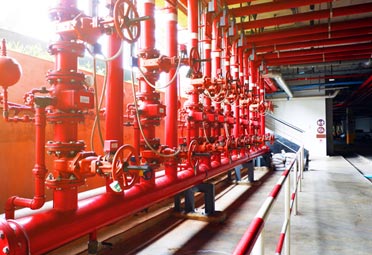
Ultrasonic Pipe Testing for Commercial Fire Protection Systems
Shortly after commercial and industrial structures became multi-story and expansive, the need for fire suppression became very apparent. Building engineers began experimenting with fire sprinkler systems in the early 1700s.
Today, fire safety systems are designed into every commercial and multi-family residential facility by law in local, state, and Federal building codes. These fire safety systems have tremendous effectiveness in alerting occupants and first responders of the presence of a fire and suppressing the fire at its source.
Fire safety systems include fire sprinkler systems, a network of pipes containing water, and heat-sensitive sprinkler heads that shower water to suppress a fire. The current building code positions sprinkler heads every 6’, so the network of pipes in any given building is quite large.
The goal for every fire sprinkler network is to never see use. However, this leaves water inside a closed system for many years. Municipal or well water that contains dissolved chemical salts will result in corrosion of pipe walls over time. While chemical treatments can be added to the system to reduce corrosion. in the last 25 years, the corrosion threat has increased dramatically.
- Poor chemical treatment. Effective chemical treatment is less common. Often less-effective measures are taken, or treatment is neglected altogether.
- Pipe quality. Value engineering during construction often leads to systems being installed with undersized pipe walls or pipes from foreign manufacturing sources with low material standards. Welded pipe is much more common than seamless, extruded pipes.
- Poor coatings. The corrosion-resistant coatings on pipes are applied thinner as a cost-saving measure.
- Green building design and operation guidelines favor standards that lead to higher rates of corrosion.
For many years, the accepted method of investigating corrosion has been to shut the system down, drain the water, remove samples of pipe, weld new sections to the network, pressurize the network to check for leaks, and test the entire system. Admittedly, this method was like searching for a needle in a haystack.
- Samples are generally taken from easily accessible pipes
- Small diameter pipes are preferred above large diameter pipes
- The emphasis is often getting business operations going again; “get in and get out” is the order of the day
Therefore, critical capital decisions are made on limited information—a very risky plan.
A newer, less invasive method of testing includes the use of ultrasound for pipe assessment and evaluation. Many are familiar with ultrasound from medical procedures, as it creates images inside the human body without any surgical openings.
Ultrasonic Pipe Testing has been around since the 1950s and is commonly used for metallurgical assessment in aviation and aerospace technology, marine, military, and nuclear power applications. It is currently being used as a diagnostic tool to investigate pipe corrosion in fire sprinkler systems.
Ultrasonic Pipe Testing is safe for both building materials and testers, providing an accurate and reliable image of pipe walls and interiors. It can be used on different sizes of pipes from both horizontal and vertical applications. Connections, including threads and welds, can be examined.
Much larger segments of pipe can be investigated in a shorter period of time, without shutting down the system or interfering with business operations.
With knowledge of pipe material and thickness, the cause and nature of corrosion, a better analysis of pipe conditions can be made. A baseline for wall thickness is recorded to assist with subsequent investigations.
An ultrasound may uncover a uniform reduction in pipe wall thickness or fluctuations in pipe wall thickness, indicating pitting. The Ultrasonic Pipe Testing may also discover no evidence of significant corrosion. Recommendations will be made based on the results of the findings.
Benefits of using Ultrasonic Pipe Testing include:
- A saving of time and cost, stemming from a non-invasive investigation
- A more thorough investigation is possible
- The opportunity for business owners to be proactive rather than reactive
- Better information is available for making capital decisions
Are you in need of an Ultrasonic Pipe Testing of your fire protection system?
Call Fire Safe Protection Services today at 713-722-7800 or visit our online form and we will be in contact as soon as possible about your questions regarding Ultrasonic Pipe Testing.